Status & feedback
A five-star graphic without a number behind it is just decoration
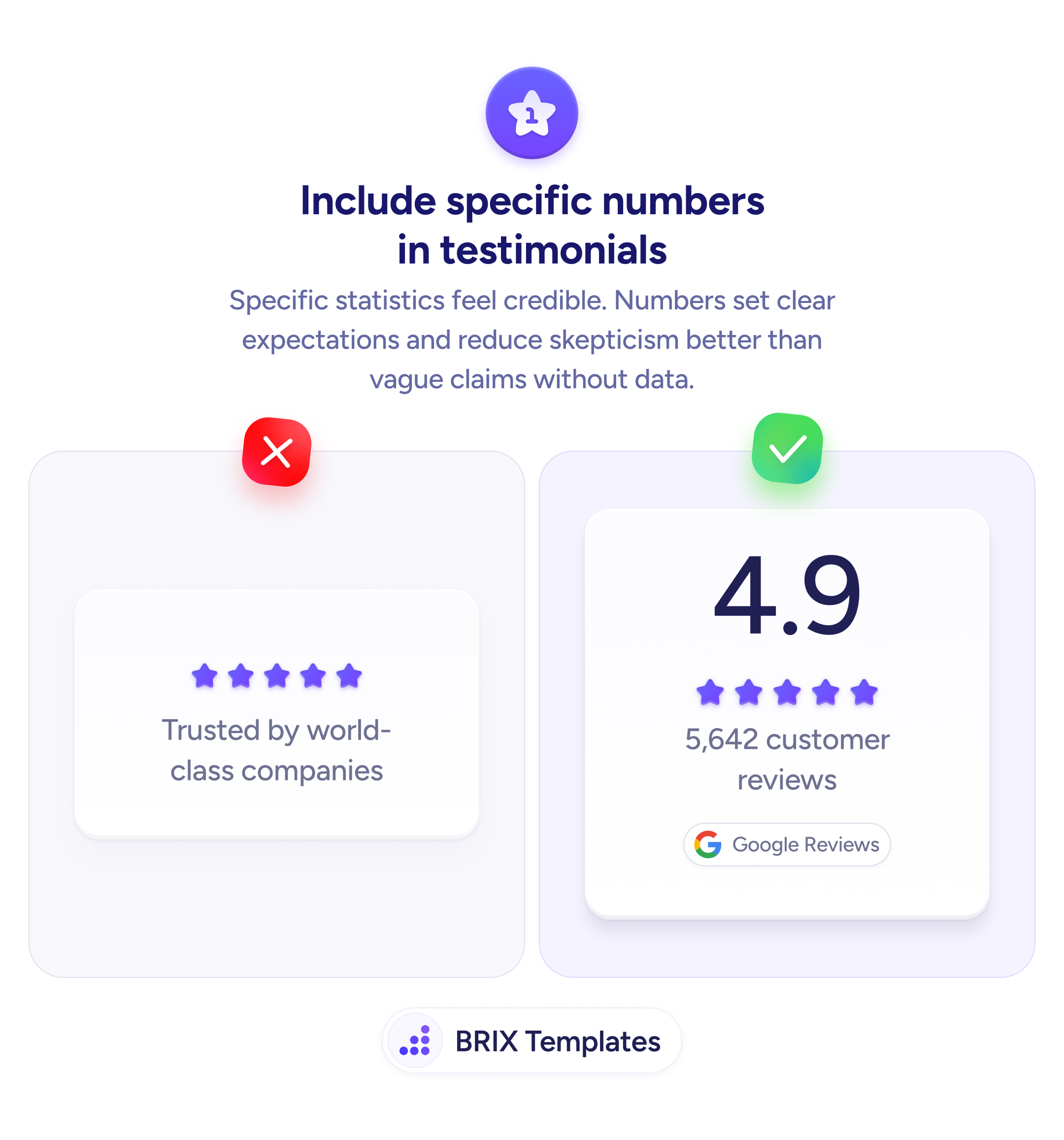
Vague claims like 'trusted by world-class companies' trigger skepticism. Show exact ratings, review counts, and third-party sources instead.

Status & feedback
A five-star graphic without a number behind it is just decoration
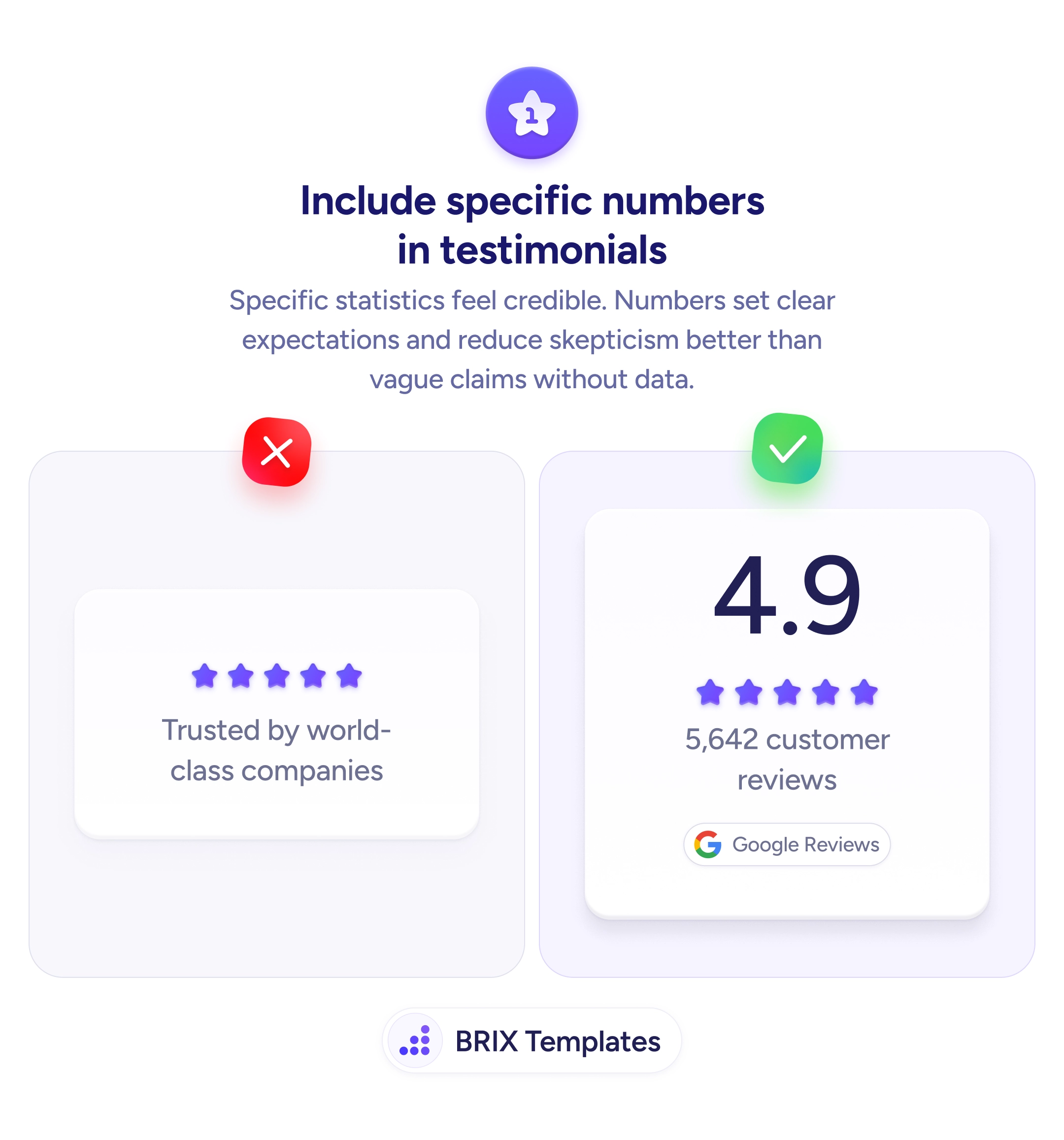
Vague claims like 'trusted by world-class companies' trigger skepticism. Show exact ratings, review counts, and third-party sources instead.
When social proof relies on vague claims like “trusted by world-class companies” or a generic five-star graphic, users often treat it as marketing decoration. There is no way to verify the claim, no sense of scale, and nothing concrete to evaluate. The result is a trust signal that can actually trigger skepticism instead of reducing it.
A stronger approach is to replace generic praise with specific, verifiable data. Show the exact rating (“4.9”), the precise number of reviews (“5,642 customer reviews”), and a recognizable third-party source like a Google Reviews badge. Each of these details gives the user something concrete to assess — and the specificity itself signals that the data is real, not curated.
To apply this, audit your existing testimonial and review sections for vague language. Any claim that cannot be independently checked is a candidate for replacement. Pair numerical data with a source attribution so users know where the numbers come from. A verified source badge adds a layer of credibility that self-reported numbers alone cannot match.
Specific, sourced numbers can make social proof feel like evidence rather than advertising. This kind of detail typically helps users move past skepticism faster because they have something real to evaluate.
Numbers give users something concrete to evaluate. A rating of 4.9 from 5,642 reviews carries statistical weight — users can gauge both quality and sample size, which makes the claim feel verifiable rather than curated.
Claims like 'trusted by world-class companies' offer no way to verify the statement. Users recognize this as marketing language, which can trigger skepticism and actually reduce trust rather than build it.
Yes. A recognized third-party badge (Google, Trustpilot) signals independent collection. Self-reported numbers without attribution can feel like the company cherry-picked favorable data.
More is better, but context matters. A 4.9 from 50 reviews is still more convincing than a generic 5-star graphic with no count. The key is transparency — showing the actual number lets users judge for themselves.